Zaczniemy nasz tekst od szyfru Playfair, gdyż jego innowacyjność dała początek szyfrom dwukwadratowym i czterokwadratowym. Wymyślony w roku 1854 przez Charlesa Wheatstone’a szyfra należy do rodziny szyfrów podstawieniowych poligramowych, polega na zastąpieniu par liter tekstu jawnego inną parą generowaną przez określony złożony system. System ten bazuje na słowie kluczu i tablicy o wymiarach 5×5. Jeśli za klucz przyjmiemy słowo SEJF, litery alfabetu łacińskiego zapisujemy w tablicy, zaczynając od słowa klucza, obie strony muszą wcześniej ustalić, w jakiej konfiguracji będzie wpisywany klucz i reszta liter. Jak łatwo się domyślić liter w alfabecie łacińskim jest 26 a kwadrat 5×5 generuje 25 pól, toteż litery „I” i „J” możemy potraktować wspólnie lub pominąć literę rzadko występującą w obiegu, taką jak X lub V.
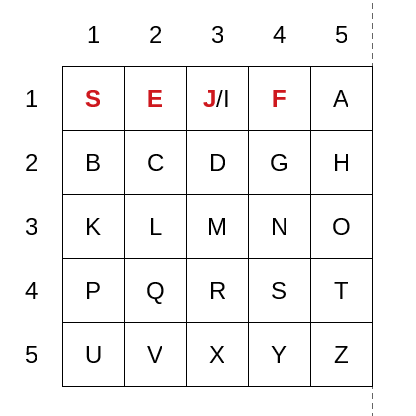
Jeśli litery w kluczu powtarzają się to następna litera, zostaje pominięta (DOROTA–>DORTA). Tekst jawny dzielony jest na diagramy (pary liter), które powinny składać się z dwóch różnych od siebie liter, w razie konieczności można dodać mało używaną literę jako separator, również, jeśli liter w jawnej wiadomości jest nieparzysta, ilość należy do ostatniej litery dodać mało występującą literę. Tekst „tajny szyfr” podzielimy na:
ta-jn-ys-zy-fr
Słowo „message” podzielimy na:
me-sx-sa-ge
dodajemy mało używaną literę „x” aby odseparować powtarzające się litery.
Słowo „szyfr” podzielimy następująco:
sz-yf-rx
W pełnym zdaniu pozbywamy się spacji i znaków interpunkcyjnych:
tekst „To jest tajna wiadomość!” przekształcimy na „tojesttajnawiadomosc” i podzielimy:
to-je-st-ta-jn-aw-ia-do-mo-sc
Szyfrując tekst, kierujemy się następującymi warunkami:
- Jeśli obie litery są w tym samym wierszu, zastępujemy je występującymi po nich (cyklicznie) literami.
- Jeśli obie litery są w tej samej kolumnie, zastępujemy je literami, które są pod nimi.
- Jeśli litery, znajdują się na pozycji x,y i a,b to zastępujemy je literami znajdującymi się na pozycji x,b i a,y
Przykład:
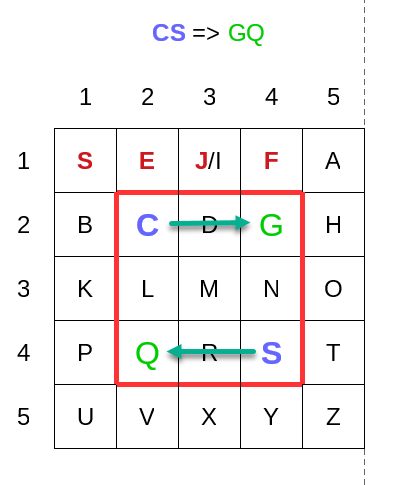
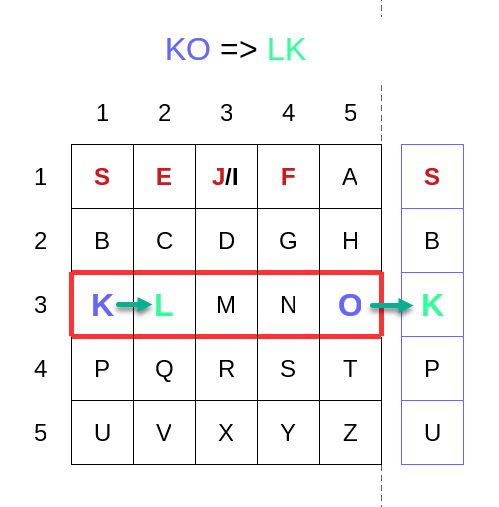
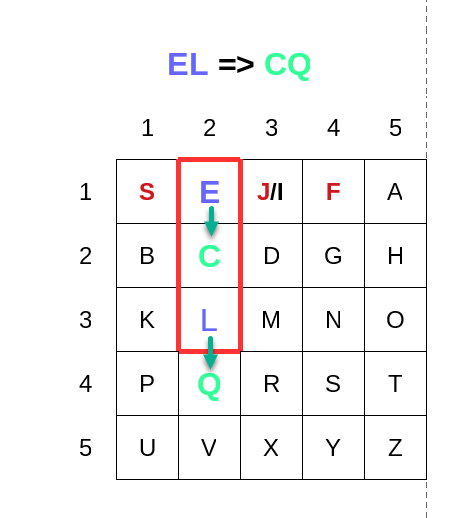
Gdy znamy już zasady szyfru Playfair, zrobimy sobie program, który będzie szyfrował tekst przy użyciu tego sposobu. Będzie to bardzo prosta aplikacja.
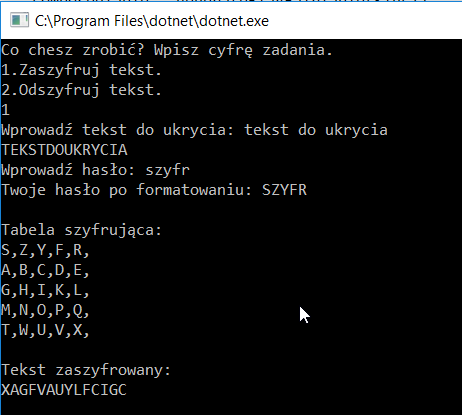
Nasz ukryty tekst przy użyciu klucza „SZYFR” to XAGFVAUYLFCIGC
Po odszyfrowaniu:
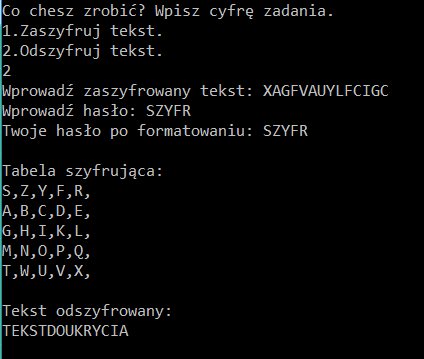
Kod aplikacji dostępny tutaj:
Imports System
Imports System.Text

Module Program
    'skomponowana tabela
    Dim composedTable As New List(Of String)
    'tabela startowa, jej modyfikacja utrudnia złamanie szyfru
    Dim startTable As New List(Of String)(New String() {"A", "B", "C", "D", "E",
                                                        "F", "G", "H", "I", "K",
                                                        "L", "M", "N", "O", "P",
                                                        "Q", "R", "S", "T", "W",
                                                        "U", "V", "X", "Y", "Z"})
    'tekst do ukrycia lub odszyfrowania
    Dim hiddenText As String
    'tekst po zaszyfrowaniu
    Dim textAfterEncription As String
    'tekst po odszyfrowaniu
    Dim textAfterDecription As String

    Sub Main(args As String())
        ''''proste menu użytkownika
        Console.WriteLine("Co chesz zrobić? Wpisz cyfrę zadania." + vbNewLine + "1.Zaszyfruj tekst." _
                          + vbNewLine + "2.Odszyfruj tekst.")
        Dim zad As String
        Do
            zad = Console.ReadLine()
            If zad = "1" Or zad = "2" Then
                Exit Do
            Else
                Console.WriteLine("możesz wybrać tylko cyfrę 1 lub 2.")
            End If
        Loop
        '''''
        If zad = 1 Then
            'użytkownik chce zaszyfrować tekst
            Console.Write("Wprowadź tekst do ukrycia: ")
            'pobierz tekst do zaszyfrowania od użytkownika
            hiddenText = formatText(textFromConsole(), False)
            'wyświetl użytkownikowi tekst po formatowaniu
            '--zamienia polskie znaki, usówa spacje, przecinki ip
            displayFormatedText(hiddenText)
            'pobiera od użytkownika hasło do szyfrowania
            Console.Write("Wprowadź hasło: ")
            Dim klucz As String = Console.ReadLine()
            'formatuje klucz
            klucz = formatText(klucz, True)
            'usówa powtarzające się litery
            klucz = formatKey(klucz)
            'wyświetla sformatowany klucz
            Console.Write("Twoje hasło po formatowaniu: " + klucz + vbNewLine)
            'generuje i wyświetla sformatowaną tabele
            Console.Write(vbNewLine + "Tabela szyfrująca:" + vbNewLine)
            composedTable = generatePlayFairTable(klucz)
            displayTable()
            'szyfruje i wyświetla zaszyfrowaną wiadomość
            Console.Write(vbNewLine + "Tekst zaszyfrowany:" + vbNewLine)
            textAfterEncription = encryptText(hiddenText, composedTable, True)
            displayFormatedText(textAfterEncription)
        Else
            Console.Write("Wprowadź zaszyfrowany tekst: ")
            hiddenText = formatText(textFromConsole(), False)

            Console.Write("Wprowadź hasło: ")
            Dim klucz As String = Console.ReadLine()

            klucz = formatText(klucz, True)
            klucz = formatKey(klucz)
            Console.Write("Twoje hasło po formatowaniu: " + klucz + vbNewLine)

            Console.Write(vbNewLine + "Tabela szyfrująca:" + vbNewLine)
            composedTable = generatePlayFairTable(klucz)

            displayTable()

            Console.Write(vbNewLine + "Tekst odszyfrowany:" + vbNewLine)
            textAfterDecription = encryptText(hiddenText, composedTable, False)

            displayFormatedText(textAfterDecription)
        End If
        Console.ReadLine()
    End Sub

    Private Function textFromConsole() As String
        'element ten służy do pobrania tekstu od użytkownika
        Dim tekstDoUkrycia = New StringBuilder()
        While True
            Dim cki As ConsoleKeyInfo = Console.ReadKey(True)
            Select Case cki.Key
                Case ConsoleKey.Enter
                    ' Koniec wprowadzania
                    Console.WriteLine()
                    Exit While
                Case ConsoleKey.Backspace
                    ' Usówanie ostatniego znaku
                    If tekstDoUkrycia.Length > 0 Then
                        tekstDoUkrycia.Remove(tekstDoUkrycia.Length - 1, 1)
                        Console.Write(vbBack & " " & vbBack)
                    End If
                Case Else
                    ' Dodaje znaki do zmiennej string
                    tekstDoUkrycia.Append(cki.KeyChar)
                    Console.Write(cki.KeyChar)
            End Select
        End While

        Return tekstDoUkrycia.ToString
    End Function

    Private Function formatText(text As String, isKey As Boolean) As String
        'formatuje nasz tekst, usówa spacje i zamienia wybrane elementy
        Dim formatedTekst As String = text.Trim.ToUpper
        formatedTekst = formatedTekst.Replace(" ", "")
        formatedTekst = formatedTekst.Replace(",", "")
        formatedTekst = formatedTekst.Replace("!", "")
        formatedTekst = formatedTekst.Replace("?", "")
        formatedTekst = formatedTekst.Replace("Ą", "A")
        formatedTekst = formatedTekst.Replace("Ę", "E")
        formatedTekst = formatedTekst.Replace("Ó", "O")
        formatedTekst = formatedTekst.Replace("Ś", "S")
        formatedTekst = formatedTekst.Replace("Ł", "L")
        formatedTekst = formatedTekst.Replace("Ż", "Z")
        formatedTekst = formatedTekst.Replace("Ź", "Z")
        formatedTekst = formatedTekst.Replace("Ć", "C")
        formatedTekst = formatedTekst.Replace("Ń", "N")
        'ten element zasługuje na szczególną uwagę ponieważ jest odpowiedzialny za
        'zamiane litery J na literę I
        formatedTekst = formatedTekst.Replace("J", "I")

        If isKey = False Then
StartOver:
            For i As Integer = 0 To formatedTekst.Length - 1
                If Not ((i + 1) Mod 2) = 0 Then
                    'nieparzysta litera
                    'nie ostatnia
                    If Not i = formatedTekst.Length - 1 Then
                        'następna litera jest taka sama jak pierwsza
                        If formatedTekst(i) = formatedTekst(i + 1) Then
                            Select Case formatedTekst(i)
                            'jeśli literą powtarzającą się jest X wtedy dodajemy Y
                                Case "X"
                                    formatedTekst = formatedTekst.Insert(i + 1, "Y")
                                    GoTo StartOver
                                Case Else
                                    formatedTekst = formatedTekst.Insert(i + 1, "X")
                                    GoTo StartOver
                            End Select
                        End If
                    Else
                        formatedTekst = formatedTekst.Insert(i + 1, "X")
                    End If
                End If
            Next
        End If
        Return formatedTekst
    End Function

    Private Function formatKey(key As String) As String
        'usówa powtarzające się litery
        Dim formatedKey As String = ""
        For i As Integer = 0 To key.Length - 1
            If Not formatedKey.Contains(key(i)) Then
                formatedKey += key(i)
            End If
        Next
        Return formatedKey
    End Function

    Private Function generatePlayFairTable(key As String) As List(Of String)
        'zwraca sformatowaną tabelę połączoną z kluczem
        Dim newTable As New List(Of String)
        newTable = startTable
        For i As Integer = key.Length - 1 To 0 Step -1
            For j As Integer = 0 To newTable.Count - 1
                If key(i) = newTable(j) Then
                    newTable.RemoveAt(j)
                    Exit For
                End If
            Next
            newTable.Insert(0, key(i))
        Next

        Return newTable
    End Function

    Private Sub displayFormatedText(text As String)
        'wyświetla sformatowany tekst
        For i As Integer = 0 To text.Length - 1
            If ((i + 1) Mod 2) = 0 Then
                Console.Write(text(i - 1) + text(i)) ' + "-")
            End If
        Next
        Console.Write(vbNewLine)
    End Sub

    Private Sub displayTable()
        'wyświetli tabele
        For i As Integer = 0 To composedTable.Count - 1
            Console.Write(composedTable(i) + ",")
            If ((i + 1) Mod 5) = 0 Then
                Console.Write(vbNewLine)
            End If
        Next
    End Sub

    Private Function encryptText(text As String, encryptTable As List(Of String), crypt As Boolean) As String
        'funkcja szyfrująca i deszyfrująca tekst
        Dim cryptedText As String = ""
        Dim myKeyArray(5, 5) As String

        Dim rowNum As Integer = 0
        Dim columnNum As Integer = 0

        For i As Integer = 0 To composedTable.Count - 1
            myKeyArray(rowNum, columnNum) = composedTable(i)
            columnNum += 1
            If ((i + 1) Mod 5) = 0 Then
                rowNum += 1
                columnNum = 0
            End If
        Next

        For i As Integer = 0 To text.Length - 1
            If ((i + 1) Mod 2) = 0 Then
                Dim indexOfFirstLetter As Integer() = indexOf(text(i - 1))
                Dim indexOfSecoundLetter As Integer() = indexOf(text(i))

                If indexOfFirstLetter(0) = indexOfSecoundLetter(0) Then
                    'Równe wiersze
                    cryptedText += sameColumn(indexOfFirstLetter, indexOfSecoundLetter, myKeyArray, crypt)
                ElseIf indexOfFirstLetter(1) = indexOfSecoundLetter(1) Then
                    'Równe kolumny
                    cryptedText += sameRow(indexOfFirstLetter, indexOfSecoundLetter, myKeyArray, crypt)
                Else
                    cryptedText += diffColumnRow(indexOfFirstLetter, indexOfSecoundLetter, myKeyArray, crypt)
                End If
            End If
        Next

        Return cryptedText
    End Function

    Private Function indexOf(letter As String) As Integer()
        'sprawdza indeks litery w tabeli
        Dim index As Integer = composedTable.IndexOf(letter) + 1
        Dim rowIndex = index Mod 5
        If rowIndex = 0 Then
            rowIndex = 5
        End If
        Return {rowIndex - 1, Math.Ceiling(index / 5) - 1}
    End Function

    Private Function sameRow(firstLetter As Integer(), secoundLetter As Integer(), keyArray(,) As String,
                             left As Boolean) As String
        'wiemy, że wiersze są róne więc należy przeprowadzić transformacje -1 w lewo
        'jeśli kolumna ma index 0 wtedy będzie to index 5
        Dim cipheredtext As String = ""
        Dim columnNum As Integer = firstLetter(1)

        If left = True Then
            'odszyfruj, jeden w prawo
            If firstLetter(0) + 1 > 4 Then
                cipheredtext += keyArray(columnNum, 0)
            Else
                cipheredtext += keyArray(columnNum, firstLetter(0) + 1)
            End If

            If secoundLetter(0) + 1 > 4 Then
                cipheredtext += keyArray(columnNum, 0)
            Else
                cipheredtext += keyArray(columnNum, secoundLetter(0) + 1)
            End If
        Else
            'szyfruj, jeden w lewo
            If firstLetter(0) - 1 < 0 Then
                cipheredtext += keyArray(columnNum, 4)
            Else
                cipheredtext += keyArray(columnNum, firstLetter(0) - 1)
            End If

            If secoundLetter(0) - 1 < 0 Then
                cipheredtext += keyArray(columnNum, 4)
            Else
                cipheredtext += keyArray(columnNum, secoundLetter(0) - 1)
            End If
        End If

        Return cipheredtext
    End Function

    Private Function sameColumn(firstLetter As Integer(), secoundLetter As Integer(), keyArray(,) As String,
            down As Boolean) As String
        'wiemy, że wiersze są róne więc należy przeprowadzić transformacje -1 w lewo
        'jeśli kolumna ma index 0 wtedy będzie to index 5
        Dim cipheredtext As String = ""
        Dim rowNum As Integer = firstLetter(0)
        If down = True Then
            'szyfruj, jedne w dół
            If firstLetter(1) + 1 > 4 Then
                cipheredtext += keyArray(0, rowNum)
            Else
                cipheredtext += keyArray(firstLetter(1) + 1, rowNum)
            End If

            If secoundLetter(1) + 1 > 4 Then
                cipheredtext += keyArray(0, rowNum)
            Else
                cipheredtext += keyArray(secoundLetter(1) + 1, rowNum)
            End If
        Else
            'odszyfruj, jeden w góre
            If firstLetter(1) - 1 < 0 Then
                cipheredtext += keyArray(4, rowNum)
            Else
                cipheredtext += keyArray(firstLetter(1) - 1, rowNum)
            End If

            If secoundLetter(1) - 1 < 0 Then
                cipheredtext += keyArray(4, rowNum)
            Else
                cipheredtext += keyArray(secoundLetter(1) - 1, rowNum)
            End If
        End If

        Return cipheredtext
    End Function

    Private Function diffColumnRow(firstLetter As Integer(), secoundLetter As Integer(), keyArray(,) As String,
            crypt As Boolean) As String
        Dim cipheredtext As String = ""
        If crypt = True Then
            'szyfruj
            cipheredtext += keyArray(firstLetter(1), secoundLetter(0))
            cipheredtext += keyArray(secoundLetter(1), firstLetter(0))
        Else
            'odszyfruj
            cipheredtext += keyArray(firstLetter(1), secoundLetter(0))
            cipheredtext += keyArray(secoundLetter(1), firstLetter(0))
        End If

        Return cipheredtext
    End Function

End Module
projekt: Playfair
sama aplikacja: PlayFair_aplikacja
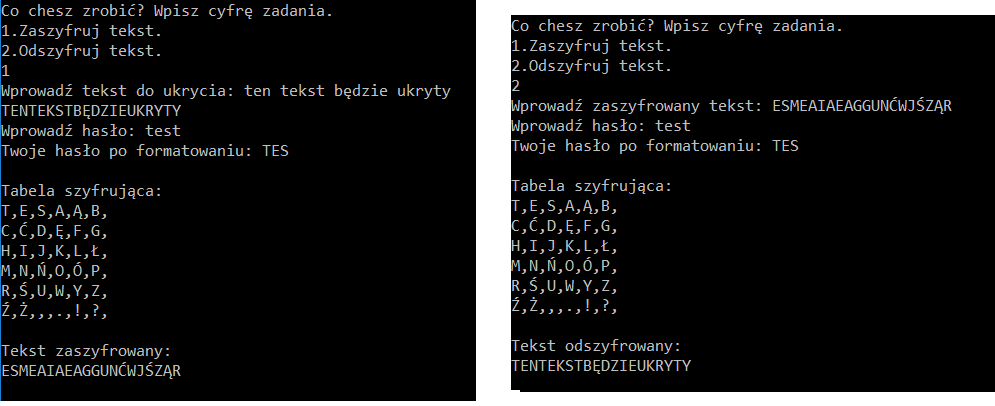
Wiemy już, czym jest szyfr PlayFair, ale czy jego stosowanie ma sens w obecnych czasach? Nie można przy jego użyciu szyfrować cyfr i ma wiele ograniczeń co do ilości liter. Każde rozszerzenie tego szyfru wiąże się z koniecznością powiększania wielkości naszej tabeli. Jeśli przyjmiemy, że w języku polskim jest 32 litery wtedy najbliższy kwadrat, który możemy wygenerować, będzie złożony z sześciu wierszy i kolumn a i tak będziemy musieli dodać znaki które nie są literami. Przekształcenie tego programu wyglądało by jak:
Imports System
Imports System.Text

Module Program
    'skomponowana tabela
    Dim composedTable As New List(Of String)
    'tabela startowa, jej modyfikacja utrudnia złamanie szyfru
    Dim startTable As New List(Of String)(New String() {"A", "Ą", "B", "C", "Ć", "D",
                                                        "E", "Ę", "F", "G", "H", "I",
                                                        "J", "K", "L", "Ł", "M", "N",
                                                        "Ń", "O", "Ó", "P", "R", "S",
                                                        "Ś", "T", "U", "W", "Y", "Z",
                                                        "Ź", "Ż", ",", ".", "!", "?"})
    'tekst do ukrycia lub odszyfrowania
    Dim hiddenText As String
    'tekst po zaszyfrowaniu
    Dim textAfterEncription As String
    'tekst po odszyfrowaniu
    Dim textAfterDecription As String

    Sub Main(args As String())
        ''''proste menu użytkownika
        Console.WriteLine("Co chesz zrobić? Wpisz cyfrę zadania." + vbNewLine + "1.Zaszyfruj tekst." _
                          + vbNewLine + "2.Odszyfruj tekst.")
        Dim zad As String
        Do
            zad = Console.ReadLine()
            If zad = "1" Or zad = "2" Then
                Exit Do
            Else
                Console.WriteLine("możesz wybrać tylko cyfrę 1 lub 2.")
            End If
        Loop
        '''''
        If zad = 1 Then
            'użytkownik chce zaszyfrować tekst
            Console.Write("Wprowadź tekst do ukrycia: ")
            'pobierz tekst do zaszyfrowania od użytkownika
            hiddenText = formatText(textFromConsole(), False)
            'wyświetl użytkownikowi tekst po formatowaniu
            '--zamienia polskie znaki, usówa spacje, przecinki ip
            displayFormatedText(hiddenText)
            'pobiera od użytkownika hasło do szyfrowania
            Console.Write("Wprowadź hasło: ")
            Dim klucz As String = Console.ReadLine()
            'formatuje klucz
            klucz = formatText(klucz, True)
            'usówa powtarzające się litery
            klucz = formatKey(klucz)
            'wyświetla sformatowany klucz
            Console.Write("Twoje hasło po formatowaniu: " + klucz + vbNewLine)
            'generuje i wyświetla sformatowaną tabele
            Console.Write(vbNewLine + "Tabela szyfrująca:" + vbNewLine)
            composedTable = generatePlayFairTable(klucz)
            displayTable()
            'szyfruje i wyświetla zaszyfrowaną wiadomość
            Console.Write(vbNewLine + "Tekst zaszyfrowany:" + vbNewLine)
            textAfterEncription = encryptText(hiddenText, composedTable, True)
            displayFormatedText(textAfterEncription)
        Else
            Console.Write("Wprowadź zaszyfrowany tekst: ")
            hiddenText = formatText(textFromConsole(), False)

            Console.Write("Wprowadź hasło: ")
            Dim klucz As String = Console.ReadLine()

            klucz = formatText(klucz, True)
            klucz = formatKey(klucz)
            Console.Write("Twoje hasło po formatowaniu: " + klucz + vbNewLine)

            Console.Write(vbNewLine + "Tabela szyfrująca:" + vbNewLine)
            composedTable = generatePlayFairTable(klucz)

            displayTable()

            Console.Write(vbNewLine + "Tekst odszyfrowany:" + vbNewLine)
            textAfterDecription = encryptText(hiddenText, composedTable, False)

            displayFormatedText(textAfterDecription)
        End If
        Console.ReadLine()
    End Sub

    Private Function textFromConsole() As String
        'element ten służy do pobrania tekstu od użytkownika
        Dim tekstDoUkrycia = New StringBuilder()
        While True
            Dim cki As ConsoleKeyInfo = Console.ReadKey(True)
            Select Case cki.Key
                Case ConsoleKey.Enter
                    ' Koniec wprowadzania
                    Console.WriteLine()
                    Exit While
                Case ConsoleKey.Backspace
                    ' Usówanie ostatniego znaku
                    If tekstDoUkrycia.Length > 0 Then
                        tekstDoUkrycia.Remove(tekstDoUkrycia.Length - 1, 1)
                        Console.Write(vbBack & " " & vbBack)
                    End If
                Case Else
                    ' Dodaje znaki do zmiennej string
                    tekstDoUkrycia.Append(cki.KeyChar)
                    Console.Write(cki.KeyChar)
            End Select
        End While

        Return tekstDoUkrycia.ToString
    End Function

    Private Function formatText(text As String, isKey As Boolean) As String
        'formatuje nasz tekst, usówa spacje i zamienia wybrane elementy
        Dim formatedTekst As String = text.Trim.ToUpper
        formatedTekst = formatedTekst.Replace(" ", "")

        If isKey = False Then
StartOver:
            For i As Integer = 0 To formatedTekst.Length - 1
                If Not ((i + 1) Mod 2) = 0 Then
                    'nieparzysta litera
                    'nie ostatnia
                    If Not i = formatedTekst.Length - 1 Then
                        'następna litera jest taka sama jak pierwsza
                        If formatedTekst(i) = formatedTekst(i + 1) Then
                            Select Case formatedTekst(i)
                            'jeśli literą powtarzającą się jest X wtedy dodajemy Y
                                Case "X"
                                    formatedTekst = formatedTekst.Insert(i + 1, "Y")
                                    GoTo StartOver
                                Case Else
                                    formatedTekst = formatedTekst.Insert(i + 1, "X")
                                    GoTo StartOver
                            End Select
                        End If
                    Else
                        formatedTekst = formatedTekst.Insert(i + 1, "X")
                    End If
                End If
            Next
        End If
        Return formatedTekst
    End Function

    Private Function formatKey(key As String) As String
        'usówa powtarzające się litery
        Dim formatedKey As String = ""
        For i As Integer = 0 To key.Length - 1
            If Not formatedKey.Contains(key(i)) Then
                formatedKey += key(i)
            End If
        Next
        Return formatedKey
    End Function

    Private Function generatePlayFairTable(key As String) As List(Of String)
        'zwraca sformatowaną tabelę połączoną z kluczem
        Dim newTable As New List(Of String)
        newTable = startTable
        For i As Integer = key.Length - 1 To 0 Step -1
            For j As Integer = 0 To newTable.Count - 1
                If key(i) = newTable(j) Then
                    newTable.RemoveAt(j)
                    Exit For
                End If
            Next
            newTable.Insert(0, key(i))
        Next

        Return newTable
    End Function

    Private Sub displayFormatedText(text As String)
        'wyświetla sformatowany tekst
        For i As Integer = 0 To text.Length - 1
            If ((i + 1) Mod 2) = 0 Then
                Console.Write(text(i - 1) + text(i)) ' + "-")
            End If
        Next
        Console.Write(vbNewLine)
    End Sub

    Private Sub displayTable()
        'wyświetli tabele
        For i As Integer = 0 To composedTable.Count - 1
            Console.Write(composedTable(i) + ",")
            If ((i + 1) Mod 6) = 0 Then
                Console.Write(vbNewLine)
            End If
        Next
    End Sub

    Private Function encryptText(text As String, encryptTable As List(Of String), crypt As Boolean) As String
        'funkcja szyfrująca i deszyfrująca tekst
        Dim cryptedText As String = ""
        Dim myKeyArray(6, 6) As String

        Dim rowNum As Integer = 0
        Dim columnNum As Integer = 0

        For i As Integer = 0 To composedTable.Count - 1
            myKeyArray(rowNum, columnNum) = composedTable(i)
            columnNum += 1
            If ((i + 1) Mod 6) = 0 Then
                rowNum += 1
                columnNum = 0
            End If
        Next

        For i As Integer = 0 To text.Length - 1
            If ((i + 1) Mod 2) = 0 Then
                Dim indexOfFirstLetter As Integer() = indexOf(text(i - 1))
                Dim indexOfSecoundLetter As Integer() = indexOf(text(i))

                If indexOfFirstLetter(0) = indexOfSecoundLetter(0) Then
                    'Równe wiersze
                    cryptedText += sameColumn(indexOfFirstLetter, indexOfSecoundLetter, myKeyArray, crypt)
                ElseIf indexOfFirstLetter(1) = indexOfSecoundLetter(1) Then
                    'Równe kolumny
                    cryptedText += sameRow(indexOfFirstLetter, indexOfSecoundLetter, myKeyArray, crypt)
                Else
                    cryptedText += diffColumnRow(indexOfFirstLetter, indexOfSecoundLetter, myKeyArray, crypt)
                End If
            End If
        Next

        Return cryptedText
    End Function

    Private Function indexOf(letter As String) As Integer()
        'sprawdza indeks litery w tabeli
        Dim index As Integer = composedTable.IndexOf(letter) + 1
        Dim rowIndex = index Mod 6
        If rowIndex = 0 Then
            rowIndex = 6
        End If
        Return {rowIndex - 1, Math.Ceiling(index / 6) - 1}
    End Function

    Private Function sameRow(firstLetter As Integer(), secoundLetter As Integer(), keyArray(,) As String,
                             left As Boolean) As String
        'wiemy, że wiersze są róne więc należy przeprowadzić transformacje -1 w lewo
        'jeśli kolumna ma index 0 wtedy będzie to index 5
        Dim cipheredtext As String = ""
        Dim columnNum As Integer = firstLetter(1)

        If left = True Then
            'odszyfruj, jeden w prawo
            If firstLetter(0) + 1 > 5 Then
                cipheredtext += keyArray(columnNum, 0)
            Else
                cipheredtext += keyArray(columnNum, firstLetter(0) + 1)
            End If

            If secoundLetter(0) + 1 > 5 Then
                cipheredtext += keyArray(columnNum, 0)
            Else
                cipheredtext += keyArray(columnNum, secoundLetter(0) + 1)
            End If
        Else
            'szyfruj, jeden w lewo
            If firstLetter(0) - 1 < 0 Then
                cipheredtext += keyArray(columnNum, 5)
            Else
                cipheredtext += keyArray(columnNum, firstLetter(0) - 1)
            End If

            If secoundLetter(0) - 1 < 0 Then
                cipheredtext += keyArray(columnNum, 5)
            Else
                cipheredtext += keyArray(columnNum, secoundLetter(0) - 1)
            End If
        End If

        Return cipheredtext
    End Function

    Private Function sameColumn(firstLetter As Integer(), secoundLetter As Integer(), keyArray(,) As String,
            down As Boolean) As String
        'wiemy, że wiersze są róne więc należy przeprowadzić transformacje -1 w lewo
        'jeśli kolumna ma index 0 wtedy będzie to index 5
        Dim cipheredtext As String = ""
        Dim rowNum As Integer = firstLetter(0)
        If down = True Then
            'szyfruj, jedne w dół
            If firstLetter(1) + 1 > 5 Then
                cipheredtext += keyArray(0, rowNum)
            Else
                cipheredtext += keyArray(firstLetter(1) + 1, rowNum)
            End If

            If secoundLetter(1) + 1 > 5 Then
                cipheredtext += keyArray(0, rowNum)
            Else
                cipheredtext += keyArray(secoundLetter(1) + 1, rowNum)
            End If
        Else
            'odszyfruj, jeden w góre
            If firstLetter(1) - 1 < 0 Then
                cipheredtext += keyArray(5, rowNum)
            Else
                cipheredtext += keyArray(firstLetter(1) - 1, rowNum)
            End If

            If secoundLetter(1) - 1 < 0 Then
                cipheredtext += keyArray(5, rowNum)
            Else
                cipheredtext += keyArray(secoundLetter(1) - 1, rowNum)
            End If
        End If

        Return cipheredtext
    End Function

    Private Function diffColumnRow(firstLetter As Integer(), secoundLetter As Integer(), keyArray(,) As String,
            crypt As Boolean) As String
        Dim cipheredtext As String = ""
        If crypt = True Then
            'szyfruj
            cipheredtext += keyArray(firstLetter(1), secoundLetter(0))
            cipheredtext += keyArray(secoundLetter(1), firstLetter(0))
        Else
            'odszyfruj
            cipheredtext += keyArray(firstLetter(1), secoundLetter(0))
            cipheredtext += keyArray(secoundLetter(1), firstLetter(0))
        End If

        Return cipheredtext
    End Function

End Module
Przykład użycia:
Można pójść dalej, jeśli w języku poskim jest 32 litery i podzielimy je na małe i duże otrzymamy okrągłą liczbę 64 = 8 * 8
Imports System
Imports System.Text

Module Program

    Dim startTable As New List(Of String)(New String() {"A", "a", "B", "b", "Ą", "ą", "C", "c",
                                                        "Ć", "ć", "D", "d", "E", "e", "Ę", "ę",
                                                        "F", "f", "G", "g", "H", "h", "I", "i",
                                                        "J", "j", "K", "k", "L", "l", "Ł", "ł",
                                                        "M", "m", "N", "n", "Ń", "ń", "O", "o",
                                                        "Ó", "ó", "P", "p", "Q", "q", "R", "r",
                                                        "S", "s", "T", "t", "U", "u", "W", "w",
                                                        "Y", "y", "Z", "z", "Ź", "ź", "Ż", "ż"})